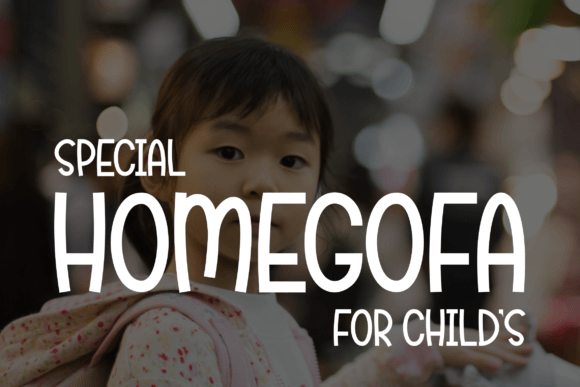
Homegofa: Integrating a Specialized Children’s Font into Creative and Educational Workflows
In the landscape of digital typography, selecting the right typeface is rarely just an aesthetic choice; it is a functional decision that impacts readability, brand perception, and user engagement. For professionals working in education, children’s publishing, toy design, or family-oriented marketing, the visual language must align with the cognitive development of the target audience. This is where Homegofa enters the workflow. As a children’s edition font from the simple script family, Homegofa is engineered with specific structural modifications—namely, a thicker stroke weight—to enhance legibility for young readers. Understanding how to integrate this asset into your creative process requires looking beyond its appearance and examining its practical application across various stages of production.
Understanding the Structural Logic of Homegofa
Before integrating any tool into a project, it is essential to understand its underlying mechanics. Homegofa belongs to the simple script family, which inherently suggests a flowing, handwritten quality. However, unlike standard script fonts that often feature thin, delicate strokes designed for adult elegance, Homegofa is made thicker than usual. This modification is not arbitrary; it serves a critical usability function. Thicker strokes reduce the visual strain on developing eyes and help distinguish individual letterforms more clearly against complex backgrounds or illustrations.
For educators and designers, this distinction is vital. Standard scripts can become illegible when scaled down for small print materials like toy tags or park signage. Homegofa addresses this by maintaining the charm of a handwritten style while providing the robustness required for early literacy support. When you approach a project involving children, whether it is designing a picture book cover or creating educational materials for a tourist attraction, recognizing this balance between form (script) and function (thickness) allows you to make informed decisions about hierarchy and contrast.
Pre-Production: Planning and Asset Management
The integration of Homegofa begins long before the final design is rendered. It starts during the planning phase of your workflow. If you are a publisher, educator, or small business owner preparing content for a young demographic, identifying the need for high-legibility script early can streamline your entire production cycle.
- Compatibility Checks: Ensure that your chosen design software supports the specific file formats of Homegofa. Whether you are using vector-based tools for logo design in parks or raster editors for social media graphics, verify that the font renders correctly at various sizes. The thickness of Homegofa may behave differently when anti-aliasing is applied on screens versus print, so testing proofs is a crucial pre-production step.
- Brand Consistency: If Homegofa is part of a broader typographic system, define its role clearly. Does it serve as the primary display font for titles, or does it complement a sans-serif body text? Establishing these rules early prevents inconsistency across different touchpoints, such as website headers, printed brochures, and product packaging.
- Licensing and Usage Rights: For entrepreneurs and freelancers, understanding the licensing terms is part of professional due diligence. Determine if the font allows for commercial use in physical goods like toys or digital assets like e-books. Proper documentation here protects your workflow from legal complications later in the distribution phase.
Implementation in Physical Products and Environments
One of the most distinct use cases for Homegofa lies in physical environments and tangible products. The font’s enhanced thickness makes it particularly suitable for applications where visibility is paramount but a friendly, approachable tone is desired.
Toys and Educational Materials
In the toy industry, labels and instruction manuals must be clear to both parents and children. Using Homegofa for key instructional text or branding on toys ensures that the message is accessible. The thicker lines prevent the text from getting lost in colorful, busy packaging designs. When implementing this, consider the scale. On small items, the weight of the font provides necessary contrast without requiring excessive size, preserving the overall aesthetic balance of the product design.
Parks and Tourist Attractions
Signage in parks and tourist attractions serves a dual purpose: wayfinding and atmosphere. Traditional sans-serif fonts are efficient but can feel sterile. Homegofa offers a solution that bridges efficiency with warmth. Its script nature evokes a sense of playfulness and narrative, fitting well in themed areas or storywalks. However, implementation here requires careful attention to environmental factors. Ensure that the font is paired with sufficient background contrast. The thickness helps, but poor color pairing can still compromise readability. Test your signage designs under actual lighting conditions to ensure that the Homegofa text remains legible from a distance and at eye level for children.
Digital Integration: Picture Books and Web Content
The digital realm presents different challenges regarding readability. Screen resolution and pixel density affect how thick strokes render. For bloggers, publishers, and creators producing digital picture books or educational web content, Homegofa can be a powerful tool for headings and pull quotes.
When integrating Homegofa into web workflows, consider the following technical adjustments:
- Responsive Scaling: Use CSS to manage font sizes dynamically. While Homegofa is thicker, it should not overwhelm smaller mobile screens. Set appropriate minimum font sizes to ensure that the character details remain distinct on high-DPI displays.
- Line Height and Spacing: Script fonts often have varying ascenders and descenders. Adjust line height and letter spacing to prevent characters from touching, which can happen more easily with thicker weights. This improves the reading flow for young users who are still mastering text recognition.
- Accessibility Compliance: For projects aiming for broad accessibility, pair Homegofa with highly readable body text. Use it for emphasis rather than long-form paragraphs. This respects the cognitive load of the reader while leveraging the font’s decorative strength.
Quality Control and Long-Term Maintenance
Once Homegofa has been implemented, ongoing quality control ensures that the intended effect is maintained. For teams managing multiple assets, consistency is key. Create a style guide that specifies exactly when and how Homegofa should be used. This document should include examples of correct and incorrect usage, such as avoiding overly tight kerning or placing the font on low-contrast backgrounds.
Furthermore, gather feedback from the end-users. In educational settings, observe how children interact with materials featuring Homegofa. Do they find it easier to read compared to other scripts? This qualitative data can inform future iterations of your content strategy. For marketers, monitor engagement metrics. If Homegofa is used in advertising campaigns targeting families, analyze click-through rates and time-on-page to gauge its effectiveness in capturing attention without causing fatigue.
Strategic Outcomes and Workflow Efficiency
Integrating Homegofa into your workflow is not merely about choosing a "cute" font; it is about optimizing communication for a specific demographic. By selecting a typeface that accounts for the visual needs of children, you demonstrate empathy and professionalism. This leads to several strategic outcomes:
- Enhanced Trust: Parents and educators are more likely to trust materials that prioritize readability and safety. A thoughtful typographic choice signals that you have considered the user experience deeply.
- Reduced Revision Cycles: By addressing legibility concerns upfront through the use of a purpose-built font like Homegofa, you reduce the need for costly revisions later in the production process.
- Stronger Brand Identity: Consistent use of Homegofa across toys, digital platforms, and physical spaces creates a cohesive brand identity that resonates with families. It becomes a recognizable visual cue associated with your products or services.
Ultimately, the value of Homegofa lies in its ability to simplify the complex task of communicating with children. It removes the guesswork from legibility, allowing creators to focus on the content and creativity of their projects. Whether you are designing a new line of educational toys, updating a children’s website, or planning signage for a community park, incorporating Homegofa into your design toolkit offers a practical, evidence-based approach to better engaging young audiences. By treating typography as a functional component of your workflow, you ensure that your final output is not only visually appealing but also effectively communicative.